

What Do You Think Of The Animation Im Jojo
Recreating the original manga with the concept of "Written report JoJo scientifically"
The request from producer Hiroyuki Omori of Warner Brothers Japan for the production of the JoJo anime was very unproblematic: "Make JoJo." In response, the director, Naokatsu Tsuda, came up with the slogan, "Study JoJo scientifically."
He picked out all the elements that made the original JoJo manga unique and searched for ways to reproduce them in animation. He thoroughly recreated unique onomatopoeic sounds such as "Memetaa" and "Gogogogo," as well as the unique poses, and theatrical dialogue such equally "I'm impressed by that! I admire you!" On acme of these, he as well replicated the use of motion lines and frame layout management in the animation.
Toshiyuki Kato, who has been directing since the first season, said, "In order to create an eerie temper, there are many depictions of fog, smoke, and other unidentifiable gases swirling around in the original manga. Commonly, this would have been done with CG, but we recreated it by mitt, merely like the original manga. In addition, when we wanted to express the disturbance of the characters, we used suspenseful techniques such as concealment the entire face up with tones and illuminating only the optics, merely equally in the original manga." The staff's attention to detail can be seen everywhere.
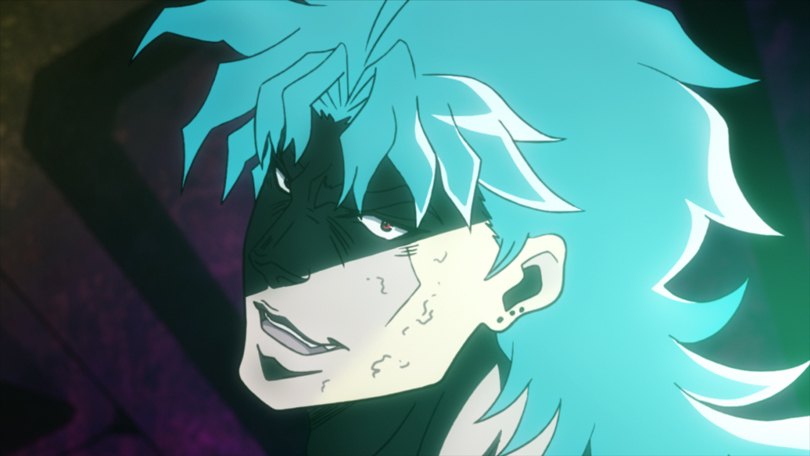
An impressive shot of Dio's optics glowing mysteriously while half of his face is covered in shadow.
The "special scene coloring" is the best part of the anime
1 notable visual issue is a color expression called "special scene coloring" or "special cutting coloring." Equally JoJo fans know, there is no fixed color scheme for JoJo. It is quite common for the same character in a color manuscript drawn by Hirohiko Araki to change color drastically from one time to the adjacent, and the fact that he is not bound past a set color scheme is one of the things that makes him unique.
However, different manga manuscripts, which are commonly drawn in black and white, animation is ever in full colour. It is not possible to alter the colors with every scene. Therefore, Tsuda and his squad decided on a bones color scheme that would serve every bit the overall base, and then adopted "special scene coloring" and "special cut coloring" to change the colors based on developments in the story. These colors are used when the character's emotions are greatly shaken, or when the story reaches a climax, and they office finer every bit accents. It is a concept that takes full reward of the characteristics of animation, and was retained every bit a major strength until the fourth season.
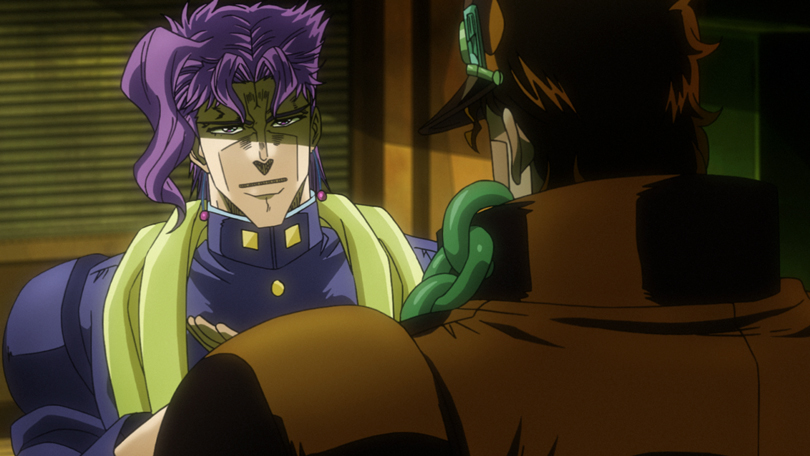
In "special color" scenes, the colors of things like uniforms and hair alter.
This is handled differently in each season.
Character designs that seek the median of fan'due south imagination
The character design was a particular point of trial and error in the visual construction of the first flavour. The characters fatigued by Hirohiko Araki in the early days were all muscular and had a drawing style similar to gekiga. Information technology is hard to say that this is in line with modern trends, so the challenge was how to bridge this gap. The production team created character designs that were closer to the mental image of the fans by finding the median value of the character designs from the 3rd to fifth parts of the original manga, since those are the graphic symbol designs that near JoJo fans imagine, and then bringing that back to the starting time flavor. The characters created in this mode are generally mild and casual, while retaining the strong atmosphere of the early on Araki characters.
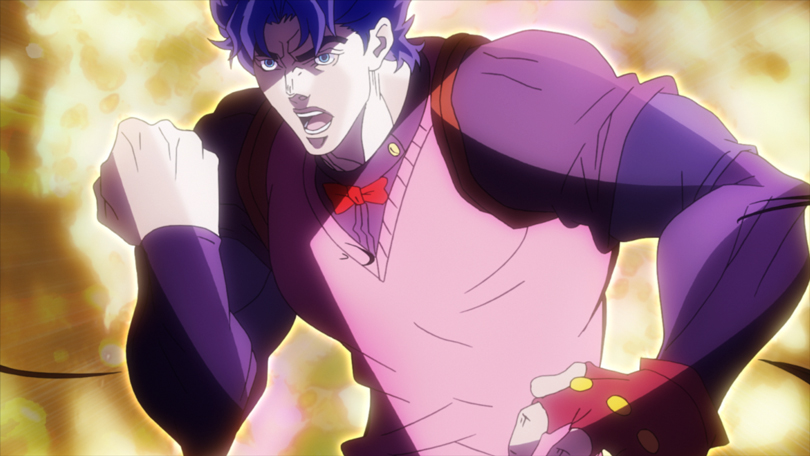
The beauty of the muscles is emphasized, but the form is slightly slimmer.
From the 19th century to the present twenty-four hour period! Fine art in Transition
Equally the era and setting of the JoJo serial changes drastically from ane part to the next, the fine art and setting work took a lot of effort. The outset season, "Phantom Blood," is set in England at the end of the 19th century, and "Battle Tendency" is gear up in America and Europe before World War Ii. These were not depicted in a realistic way in the original manga, so in a sense they were depicted as fantasy in the anime as well. The 2nd season, "Stardust Crusaders," however, takes place in the 1980s in diverse countries and regions from Nihon to Egypt. Non merely the compages, but likewise the ethnicity and article of clothing of the people who come and go are diverse, so the brunt on the art team, likewise as the sub-grapheme designers, was considerable.
The team was besides particular nigh props. For case, Suzuki, who was in accuse of the script and storyboard for episodes 37-38 "The Guardian of Hell, Pet Store," speculated that the Porsche model in the original manga might be a limited production model commonly known as the Yellow Bird, and he incorporated that into the settings. "The enemy stand at this time was a bird, and a Porsche was running into it, and so I thought that possibly Mr. Araki had a Yellow Bird in mind at the time. Well, I'thou completely imagining information technology (laughs)." (Suzuki) Honestly, in that location was no demand to think so hard about a car that only appeared in a few panels in the original manga, but that is the attention to detail that love for JoJo tin create.
The third flavor, "Diamond is Unbreakable," is a complete change from previous seasons, and is set in the fictional town of Morioh from start to finish. Kato, the director, created a precise map of the boondocks based on the original manga, and calculated the road to each character's house and school, besides as the fourth dimension required to get there. "I call up Morioh Town is the other main character of Part 4, and then I wanted to get in feel as existent as possible. I spent a lot of time creating the boondocks in order to emphasize the dissimilarity betwixt the scenery of rural Japan that anybody is familiar with and the heinous murders that are happening backside the scenes." (Kato)
The fourth season, "Golden Wind," is prepare in Italy in 2001. General managing director Tsuda and directors Yasuhiro Kimura and Hideya Takahashi traveled to Italy in July 2017 for location scouting. Kimura said, "Our goal from the beginning was to go far easy for viewers to brand a pilgrimage to the holy places," and truthful to his word, the fans managed to find most of the places that appear in the series. The results of this meticulous location scouting piece of work are captured in the film, giving viewers the feeling of having traveled all over Italy with Giorno and his friends.
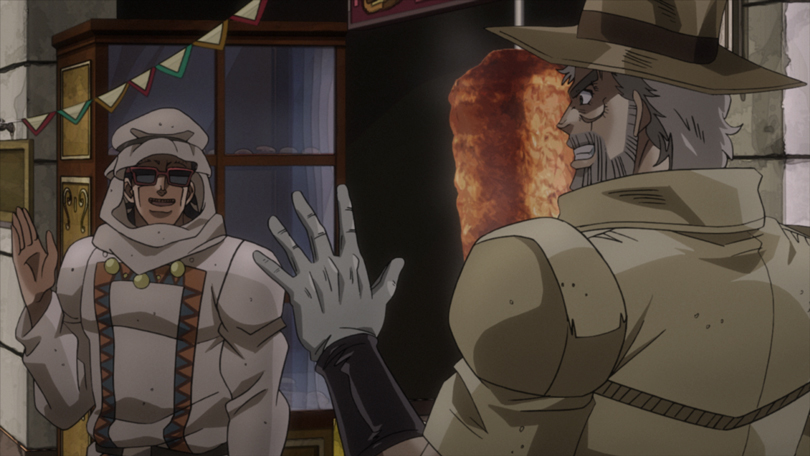
The 2nd season depicts various countries, ethnic groups, and cultures effectually the world.
The institution of "JoJo-ism" in drawing
When producer Hisataka Kasama of David Product first heard nearly the JoJo anime project, he worried, "How many animators will be able to piece of work with this design?" It was a big challenge for the studio. Although David Product is a studio that excels at creating strong images, they had never created a work with such a clear emphasis on muscles and skeletons. Kenichi Suzuki, who served equally the series director for the commencement flavour, looking back on the situation at that time, said, "When it comes to the drawings, I had a clear paradigm of the finished work from the offset, but in reality, I had to get used to information technology as I drew it."
Kato besides said that he paid item attending to the sense of weight in the drawing work in the get-go. "In the rugby scene in the second episode, there is a scene where Jonathan drags three players along simply does not stop moving forrad, which is intended to give the impression that Jonathan has grown into a powerful young man. However, Jonathan is just man and his physical strength is fundamentally unlike from that of Dio, who later on becomes a vampire and transcends humanity. In other words, it is necessary to show the limits of humanity at the same fourth dimension, and in order to practise so, information technology had to limited the weight of carrying three men on his back. The 'swell' created by the loftier load beingness applied to various parts of his trunk is very important, and I recall giving very detailed instructions on how to fix it." (Kato)
In this style, by carefully communicating the concept for each shot, the know-how gradually accumulated, and the drawing gradually stabilized. Animator Shunichi Ishimoto has been in accuse of drawing since the first flavor. "The JoJo series is basically characterized by dense drawings, so at showtime we were just drawing through trial and fault, simply soon there was a 'battle of density' among the drawing team," he says of the drawing situation at the fourth dimension.
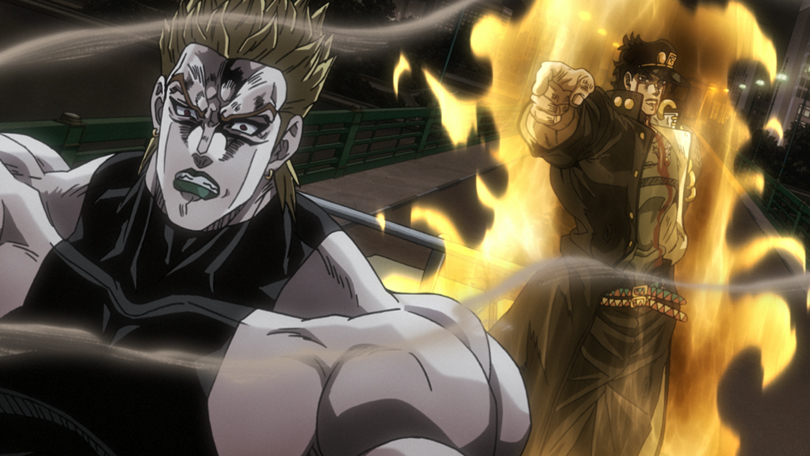
The final battle of the 2nd season has the highest level of "dense drawing" in the history of the JoJo anime.
Graphic symbol acting is similar to "stage" interim?!
The acting for the characters in JoJo is non necessarily bound by common sense. In our daily lives, we don't have the take a chance to pose in a unique way, nor exercise we take the chance to say lines like, "Exercise you recollect how much bread yous have eaten in your life?"
So the character acting in JoJo is more similar theater. Suzuki says, "While there are rules regarding the placement of characters on phase and light sources, nosotros sometimes deviate from them in order to maximize the appeal of Mr. Araki's best panels. Suddenly, the lighting is changed, or a character is put in the spotlight. It'south like 'Mie' in Kabuki." Kato refers to this as "stage interim," and it is clear that they share the same image, fifty-fifty if the words are dissimilar.
On the other manus, Tsuda describes the battles in JoJo equally "professional wrestling." "In fact, JoJo's characters are rarely worried. When professional wrestlers get into the ring, they don't worry virtually why they're fighting. They just exercise their best to arrive fun and easy to sympathise for the audition with their microphone performance and exaggerated gestures. It'south the aforementioned with JoJo's battles. Past presenting what you're going to exercise and then how it turned out, it makes the battles more than interesting. If we prioritize the anime's sense of showiness and speed, we'll lose the charm of JoJo's battles. That's why I compared it to professional wrestling." (Tsuda)
In Tsuda's analysis, the real pleasure of JoJo's battles is the groove that is created when the tempo and rhythm of long spoken lines, as well every bit the activeness, and characterization all come together, and that is what the anime is based on.
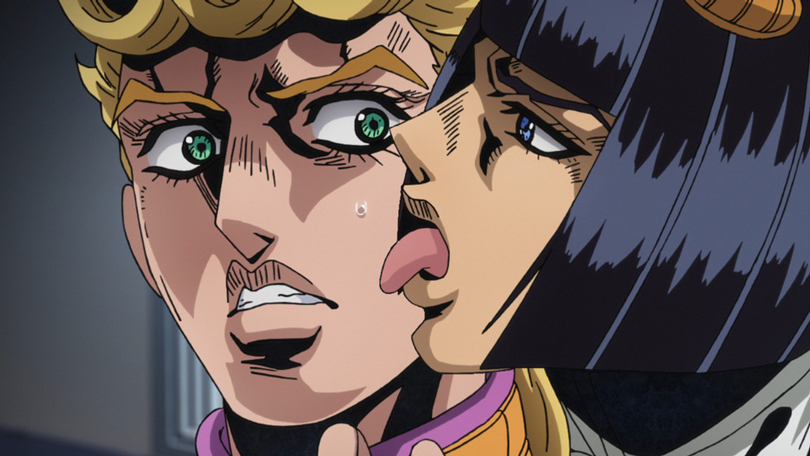
The real pleasure of JoJo battles is that they create a sense of abnormality by the unthinkable behaviors.
Interviewing and writing by Daisuke Okamoto
Source: https://jojo-portal.com/special/production-note/en/02/
Posted by: smithafteld43.blogspot.com
0 Response to "What Do You Think Of The Animation Im Jojo"
Post a Comment