

What Process In Meiosis Is Responsible For The Sterility Observed In Hybrid Animals:
| Apoptosis | |
|---|---|
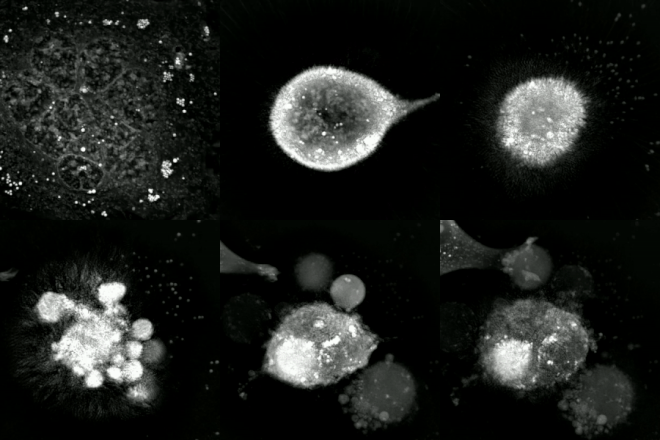
 An etoposide-treated DU145 prostate cancer cell exploding into a pour of apoptotic bodies. The sub images were extracted from a 61-hr fourth dimension-lapse microscopy video, created using quantitative stage-contrast microscopy. The optical thickness is color-coded. With increasing thickness, color changes from gray to yellow, red, purple and finally black. | |
| Identifiers | |
| MeSH | D017209 |
| Anatomical terminology [edit on Wikidata] | |

Apoptosis begins when the nucleus of the cell begins to compress. After the shrinking, the plasma membrane blebs and folds effectually different organelles. The blebs continue to form and the organelles fragment and move away from each other.
Apoptosis (from Ancient Greek: ἀπόπτωσις, romanized: apóptōsis , lit.''falling off'') is a form of programmed cell decease that occurs in multicellular organisms.[1] Biochemical events lead to feature cell changes (morphology) and expiry. These changes include blebbing, cell shrinkage, nuclear fragmentation, chromatin condensation, Dna fragmentation, and mRNA disuse. The average developed human being loses between 50 and 70 billion cells each solar day due to apoptosis.[a] For an average human child between eight and fourteen years old, approximately twenty to thirty billion cells die per twenty-four hour period.[iii]
In contrast to necrosis, which is a form of traumatic cell decease that results from acute cellular injury, apoptosis is a highly regulated and controlled process that confers advantages during an organism's life cycle. For example, the separation of fingers and toes in a developing human embryo occurs because cells between the digits undergo apoptosis. Different necrosis, apoptosis produces jail cell fragments chosen apoptotic bodies that phagocytes are able to engulf and remove before the contents of the cell tin spill out onto surrounding cells and cause damage to them.[4]
Considering apoptosis cannot stop in one case it has begun, it is a highly regulated procedure. Apoptosis tin can exist initiated through one of two pathways. In the intrinsic pathway the cell kills itself considering it senses cell stress, while in the extrinsic pathway the cell kills itself considering of signals from other cells. Weak external signals may also activate the intrinsic pathway of apoptosis.[five] Both pathways induce prison cell death by activating caspases, which are proteases, or enzymes that dethrone proteins. The ii pathways both activate initiator caspases, which then activate executioner caspases, which and then impale the cell past degrading proteins indiscriminately.
In addition to its importance equally a biological phenomenon, defective apoptotic processes take been implicated in a wide diverseness of diseases. Excessive apoptosis causes atrophy, whereas an bereft amount results in uncontrolled prison cell proliferation, such as cancer. Some factors like Fas receptors and caspases promote apoptosis, while some members of the Bcl-2 family of proteins inhibit apoptosis.
Discovery and etymology [edit]
German scientist Carl Vogt was get-go to describe the principle of apoptosis in 1842. In 1885, anatomist Walther Flemming delivered a more precise description of the process of programmed cell death. However, information technology was non until 1965 that the topic was resurrected. While studying tissues using electron microscopy, John Kerr at the University of Queensland was able to distinguish apoptosis from traumatic prison cell death.[half dozen] Following the publication of a paper describing the phenomenon, Kerr was invited to join Alastair Currie, likewise as Andrew Wyllie, who was Currie's graduate educatee,[7] at University of Aberdeen. In 1972, the trio published a seminal article in the British Journal of Cancer.[viii] Kerr had initially used the term programmed cell necrosis, but in the article, the process of natural prison cell death was called apoptosis. Kerr, Wyllie and Currie credited James Cormack, a professor of Greek linguistic communication at University of Aberdeen, with suggesting the term apoptosis. Kerr received the Paul Ehrlich and Ludwig Darmstaedter Prize on March fourteen, 2000, for his clarification of apoptosis. He shared the prize with Boston biologist H. Robert Horvitz.[9]
For many years, neither "apoptosis" nor "programmed prison cell decease" was a highly cited term. Two discoveries brought cell death from obscurity to a major field of research: identification of components of the prison cell death control and effector mechanisms, and linkage of abnormalities in cell decease to man disease, in particular cancer.
The 2002 Nobel Prize in Medicine was awarded to Sydney Brenner, H. Robert Horvitz and John Sulston for their work identifying genes that control apoptosis. The genes were identified past studies in the nematode C. elegans and homologues of these genes function in humans to regulate apoptosis.

John Sulston won the Nobel Prize in Medicine in 2002, for his pioneering research on apoptosis.
In Greek, apoptosis translates to the "falling off" of leaves from a tree.[x] Cormack, professor of Greek language, reintroduced the term for medical use every bit information technology had a medical meaning for the Greeks over two k years earlier. Hippocrates used the term to hateful "the falling off of the bones". Galen extended its meaning to "the dropping of the scabs". Cormack was no doubt aware of this usage when he suggested the proper name. Debate continues over the right pronunciation, with opinion divided between a pronunciation with the second p silent ( ap-ə-TOH-sis [11] [12]) and the second p pronounced (),[11] [13] as in the original Greek.[ citation needed ] In English, the p of the Greek -pt- consonant cluster is typically silent at the beginning of a word (e.m. pterodactyl, Ptolemy), merely articulated when used in combining forms preceded by a vowel, as in helicopter or the orders of insects: diptera, lepidoptera, etc.
In the original Kerr, Wyllie & Currie paper,[8] at that place is a footnote regarding the pronunciation:
We are about grateful to Professor James Cormack of the Section of Greek, Academy of Aberdeen, for suggesting this term. The word "apoptosis" ( ἀπόπτωσις ) is used in Greek to describe the "dropping off" or "falling off" of petals from flowers, or leaves from trees. To evidence the derivation conspicuously, we advise that the stress should be on the penultimate syllable, the second half of the give-and-take existence pronounced like "ptosis" (with the "p" silent), which comes from the aforementioned root "to fall", and is already used to draw the drooping of the upper eyelid.
Activation mechanisms [edit]


Command Of The Apoptotic Mechanisms
The initiation of apoptosis is tightly regulated by activation mechanisms, considering one time apoptosis has begun, it inevitably leads to the expiry of the cell.[14] [xv] The ii best-understood activation mechanisms are the intrinsic pathway (too called the mitochondrial pathway) and the extrinsic pathway.[16] The intrinsic pathway is activated by intracellular signals generated when cells are stressed and depends on the release of proteins from the intermembrane space of mitochondria.[17] The extrinsic pathway is activated by extracellular ligands binding to cell-surface death receptors, which leads to the germination of the death-inducing signaling circuitous (DISC).[18]
A cell initiates intracellular apoptotic signaling in response to a stress,[xix] which may bring nearly jail cell suicide. The binding of nuclear receptors past glucocorticoids,[20] oestrus,[20] radiation,[20] food deprivation,[20] viral infection,[20] hypoxia,[20] increased intracellular concentration of free fatty acids[21] and increased intracellular calcium concentration,[22] [23] for instance, by damage to the membrane, can all trigger the release of intracellular apoptotic signals by a damaged jail cell. A number of cellular components, such as poly ADP ribose polymerase, may besides help regulate apoptosis.[24] Single jail cell fluctuations have been observed in experimental studies of stress induced apoptosis.[25] [26]
Earlier the actual procedure of cell decease is precipitated past enzymes, apoptotic signals must crusade regulatory proteins to initiate the apoptosis pathway. This stride allows those signals to cause cell decease, or the process to be stopped, should the jail cell no longer need to die. Several proteins are involved, but 2 main methods of regulation accept been identified: the targeting of mitochondria functionality,[27] or direct transducing the signal via adaptor proteins to the apoptotic mechanisms. An extrinsic pathway for initiation identified in several toxin studies is an increase in calcium concentration within a cell caused past drug activity, which also can cause apoptosis via a calcium bounden protease calpain.
Intrinsic pathway [edit]
The intrinsic pathway is also known equally the mitochondrial pathway. Mitochondria are essential to multicellular life. Without them, a cell ceases to respire aerobically and quickly dies. This fact forms the footing for some apoptotic pathways. Apoptotic proteins that target mitochondria bear upon them in different ways. They may cause mitochondrial swelling through the formation of membrane pores, or they may increase the permeability of the mitochondrial membrane and cause apoptotic effectors to leak out.[20] [28] They are very closely related to intrinsic pathway, and tumors ascend more frequently through intrinsic pathway than the extrinsic pathway because of sensitivity.[29] There is as well a growing trunk of testify indicating that nitric oxide is able to induce apoptosis by helping to dissipate the membrane potential of mitochondria and therefore make it more than permeable.[30] Nitric oxide has been implicated in initiating and inhibiting apoptosis through its possible action as a signal molecule of subsequent pathways that activate apoptosis.[31]
During apoptosis, cytochrome c is released from mitochondria through the actions of the proteins Bax and Bak. The mechanism of this release is enigmatic, merely appears to stalk from a multitude of Bax/Bak homo- and hetero-dimers of Bax/Bak inserted into the outer membrane.[32] Once cytochrome c is released it binds with Apoptotic protease activating gene – 1 (Apaf-i) and ATP, which then bind to pro-caspase-9 to create a protein circuitous known equally an apoptosome. The apoptosome cleaves the pro-caspase to its active form of caspase-nine, which in turn cleaves and activates pro-caspase into the effector caspase-iii.
Mitochondria also release proteins known as SMACs (second mitochondria-derived activator of caspases) into the cell'due south cytosol post-obit the increase in permeability of the mitochondria membranes. SMAC binds to proteins that inhibit apoptosis (IAPs) thereby deactivating them, and preventing the IAPs from arresting the process and therefore assuasive apoptosis to proceed. IAP also normally suppresses the activity of a group of cysteine proteases called caspases,[33] which carry out the degradation of the cell. Therefore, the bodily degradation enzymes can exist seen to be indirectly regulated by mitochondrial permeability.
Extrinsic pathway [edit]
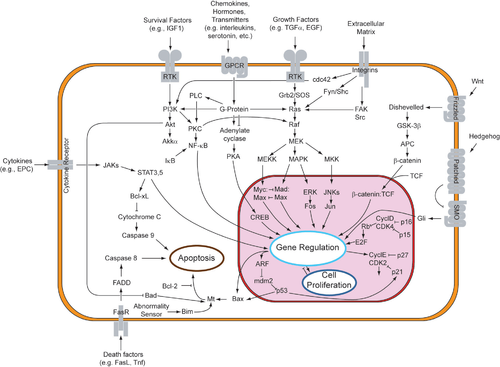
Overview of point transduction pathways.


Overview of TNF (left) and Fas (right) signalling in apoptosis, an case of direct indicate transduction.
Two theories of the direct initiation of apoptotic mechanisms in mammals have been suggested: the TNF-induced (tumor necrosis factor) model and the Fas-Fas ligand-mediated model, both involving receptors of the TNF receptor (TNFR) family[34] coupled to extrinsic signals.
TNF pathway [edit]
TNF-blastoff is a cytokine produced mainly by activated macrophages, and is the major extrinsic mediator of apoptosis. Most cells in the human body have two receptors for TNF-blastoff: TNFR1 and TNFR2. The bounden of TNF-alpha to TNFR1 has been shown to initiate the pathway that leads to caspase activation via the intermediate membrane proteins TNF receptor-associated death domain (TRADD) and Fas-associated death domain protein (FADD). cIAP1/2 tin can inhibit TNF-α signaling by binding to TRAF2. FLIP inhibits the activation of caspase-8.[35] Binding of this receptor can also indirectly lead to the activation of transcription factors involved in prison cell survival and inflammatory responses.[36] However, signalling through TNFR1 might also induce apoptosis in a caspase-independent manner.[37] The link between TNF-alpha and apoptosis shows why an abnormal product of TNF-alpha plays a fundamental role in several man diseases, particularly in autoimmune diseases. The TNF-alpha receptor superfamily also includes death receptors (DRs), such as DR4 and DR5. These receptors bind to the proteinTRAIL and mediate apoptosis. Apoptosis is known to exist 1 of the chief mechanisms of targeted cancer therapy.[38] Luminescent iridium complex-peptide hybrids (IPHs) take recently been designed, which mimic TRAIL and bind to death receptors on cancer cells, thereby inducing their apoptosis.[39]
- Fas pathway
The fas receptor (Starting time apoptosis signal) – (as well known as Apo-one or CD95) is a transmembrane protein of the TNF family which binds the Fas ligand (FasL).[34] The interaction between Fas and FasL results in the formation of the death-inducing signaling circuitous (DISC), which contains the FADD, caspase-8 and caspase-10. In some types of cells (type I), processed caspase-viii direct activates other members of the caspase family, and triggers the execution of apoptosis of the cell. In other types of cells (type Ii), the Fas-DISC starts a feedback loop that spirals into increasing release of proapoptotic factors from mitochondria and the amplified activation of caspase-8.[40]
- Mutual components
Post-obit TNF-R1 and Fas activation in mammalian cells[ citation needed ] a balance betwixt proapoptotic (BAX,[41] BID, BAK, or BAD) and anti-apoptotic (Bcl-Xl and Bcl-2) members of the Bcl-2 family are established. This balance is the proportion of proapoptotic homodimers that form in the outer-membrane of the mitochondrion. The proapoptotic homodimers are required to brand the mitochondrial membrane permeable for the release of caspase activators such as cytochrome c and SMAC. Control of proapoptotic proteins under normal cell weather of nonapoptotic cells is incompletely understood, just in full general, Bax or Bak are activated past the activation of BH3-just proteins, part of the Bcl-2 family[ citation needed ].
- Caspases
Caspases play the central role in the transduction of ER apoptotic signals. Caspases are proteins that are highly conserved, cysteine-dependent aspartate-specific proteases. There are ii types of caspases: initiator caspases, caspase ii,8,9,10,11,12, and effector caspases, caspase 3,six,7. The activation of initiator caspases requires bounden to specific oligomeric activator protein. Effector caspases are then activated by these active initiator caspases through proteolytic cleavage. The active effector caspases then proteolytically degrade a host of intracellular proteins to carry out the cell death programme.
- Caspase-independent apoptotic pathway
There as well exists a caspase-independent apoptotic pathway that is mediated past AIF (apoptosis-inducing factor).[42]
Apoptosis model in amphibians [edit]
Amphibian frog Xenopus laevis serves equally an ideal model system for the study of the mechanisms of apoptosis. In fact, iodine and thyroxine also stimulate the spectacular apoptosis of the cells of the larval gills, tail and fins in amphibians metamorphosis, and stimulate the evolution of their nervous system transforming the aquatic, vegetarian polliwog into the terrestrial, carnivorous frog.[43] [44] [45] [46]
Negative regulators of apoptosis [edit]
Negative regulation of apoptosis inhibits cell expiry signaling pathways, helping tumors to evade cell expiry and developing drug resistance. The ratio between anti-apoptotic (Bcl-2) and pro-apoptotic (Bax) proteins determines whether a cell lives or dies.[47] [48] Many families of proteins act as negative regulators categorized into either antiapoptotic factors, such every bit IAPs and Bcl-2 proteins or prosurvival factors like cFLIP, BNIP3, FADD, Akt, and NF-κB.[49]
Proteolytic caspase cascade: Killing the cell [edit]
Many pathways and signals lead to apoptosis, but these converge on a single mechanism that really causes the decease of the cell. After a prison cell receives stimulus, it undergoes organized degradation of cellular organelles by activated proteolytic caspases. In addition to the devastation of cellular organelles, mRNA is rapidly and globally degraded by a mechanism that is not still fully characterized.[50] mRNA decay is triggered very early in apoptosis.
A prison cell undergoing apoptosis shows a series of characteristic morphological changes. Early alterations include:
- Cell shrinkage and rounding occur considering of the retraction lamellipodia and the breakdown of the proteinaceous cytoskeleton by caspases.[51]
- The cytoplasm appears dumbo, and the organelles appear tightly packed.
- Chromatin undergoes condensation into compact patches against the nuclear envelope (also known as the perinuclear envelope) in a procedure known as pyknosis, a hallmark of apoptosis.[52] [53]
- The nuclear envelope becomes discontinuous and the DNA inside information technology is fragmented in a procedure referred to as karyorrhexis. The nucleus breaks into several discrete chromatin bodies or nucleosomal units due to the degradation of Deoxyribonucleic acid.[54]
Apoptosis progresses speedily and its products are rapidly removed, making information technology difficult to detect or visualize on classical histology sections. During karyorrhexis, endonuclease activation leaves short DNA fragments, regularly spaced in size. These give a feature "laddered" appearance on agar gel after electrophoresis.[55] Tests for Deoxyribonucleic acid laddering differentiate apoptosis from ischemic or toxic cell death.[56]
Apoptotic cell disassembly [edit]

Unlike steps in apoptotic prison cell disassembly.[57]
Before the apoptotic cell is tending of, there is a procedure of disassembly. There are three recognized steps in apoptotic prison cell disassembly:[58]
- Membrane blebbing: The cell membrane shows irregular buds known every bit blebs. Initially these are smaller surface blebs. After these tin can grow into larger then-chosen dynamic membrane blebs.[58] An important regulator of apoptotic prison cell membrane blebbing is ROCK1 (rho associated coiled-coil-containing poly peptide kinase 1).[59] [sixty]
- Formation of membrane protrusions: Some cell types, nether specific weather, may develop different types of long, thin extensions of the cell membrane chosen membrane protrusions. Three types have been described: microtubule spikes, apoptopodia (feet of death), and beaded apoptopodia (the latter having a beads-on-a-string appearance).[61] [62] [63] Pannexin 1 is an important component of membrane channels involved in the formation of apoptopodia and beaded apoptopodia.[62]
- Fragmentation: The jail cell breaks apart into multiple vesicles called apoptotic bodies, which undergo phagocytosis. The plasma membrane protrusions may aid bring apoptotic bodies closer to phagocytes.
Removal of dead cells [edit]
The removal of dead cells by neighboring phagocytic cells has been termed efferocytosis.[64] Dying cells that undergo the final stages of apoptosis brandish phagocytotic molecules, such as phosphatidylserine, on their cell surface.[65] Phosphatidylserine is ordinarily constitute on the inner leaflet surface of the plasma membrane, but is redistributed during apoptosis to the extracellular surface by a protein known as scramblase.[66] These molecules marker the cell for phagocytosis by cells possessing the appropriate receptors, such as macrophages.[67] The removal of dying cells by phagocytes occurs in an orderly manner without eliciting an inflammatory response.[68] During apoptosis cellular RNA and DNA are separated from each other and sorted to different apoptotic bodies; separation of RNA is initiated as nucleolar segregation.[69]
Pathway knock-outs [edit]
Many knock-outs have been made in the apoptosis pathways to test the part of each of the proteins. Several caspases, in addition to APAF1 and FADD, accept been mutated to determine the new phenotype. In order to create a tumor necrosis gene (TNF) knockout, an exon containing the nucleotides 3704–5364 was removed from the cistron. This exon encodes a portion of the mature TNF domain, likewise as the leader sequence, which is a highly conserved region necessary for proper intracellular processing. TNF-/- mice develop ordinarily and have no gross structural or morphological abnormalities. However, upon immunization with SRBC (sheep blood-red blood cells), these mice demonstrated a deficiency in the maturation of an antibody response; they were able to generate normal levels of IgM, but could not develop specific IgG levels. Apaf-1 is the protein that turns on caspase nine by cleavage to brainstorm the caspase cascade that leads to apoptosis. Since a -/- mutation in the APAF-1 gene is embryonic lethal, a gene trap strategy was used in club to generate an APAF-1 -/- mouse. This assay is used to disrupt gene part past creating an intragenic gene fusion. When an APAF-ane cistron trap is introduced into cells, many morphological changes occur, such equally spina bifida, the persistence of interdigital webs, and open encephalon. In addition, later on embryonic day 12.v, the brain of the embryos showed several structural changes. APAF-i cells are protected from apoptosis stimuli such equally irradiation. A BAX-1 knock-out mouse exhibits normal forebrain formation and a decreased programmed cell death in some neuronal populations and in the spinal cord, leading to an increase in motor neurons.
The caspase proteins are integral parts of the apoptosis pathway, and so it follows that knock-outs fabricated have varying damaging results. A caspase 9 knock-out leads to a severe brain malformation. A caspase viii knock-out leads to cardiac failure and thus embryonic lethality. Yet, with the use of cre-lox engineering, a caspase viii knock-out has been created that exhibits an increase in peripheral T cells, an impaired T cell response, and a defect in neural tube closure. These mice were found to be resistant to apoptosis mediated by CD95, TNFR, etc. but not resistant to apoptosis caused by UV irradiation, chemotherapeutic drugs, and other stimuli. Finally, a caspase 3 knock-out was characterized past ectopic prison cell masses in the brain and abnormal apoptotic features such as membrane blebbing or nuclear fragmentation. A remarkable feature of these KO mice is that they take a very restricted phenotype: Casp3, 9, APAF-1 KO mice have deformations of neural tissue and FADD and Casp viii KO showed lacking heart development, notwithstanding, in both types of KO other organs developed normally and some cell types were still sensitive to apoptotic stimuli suggesting that unknown proapoptotic pathways exist.
Methods for distinguishing apoptotic from necrotic (necroptotic) cells [edit]
Long-term alive prison cell imaging (12h) of multinucleated mouse pre-Adipocyte trying to undergo mitosis. Due to the excess of genetic material the prison cell fails to replicate and dies by apoptosis.
In order to perform assay of apoptotic versus necrotic (necroptotic) cells, i can practice analysis of morphology by label-free live cell imaging, fourth dimension-lapse microscopy, flow fluorocytometry, and transmission electron microscopy. At that place are besides various biochemical techniques for analysis of prison cell surface markers (phosphatidylserine exposure versus cell permeability past flow cytometry), cellular markers such as Deoxyribonucleic acid fragmentation[70] (flow cytometry),[71] caspase activation, Bid cleavage, and cytochrome c release (Western blotting). It is important to know how chief and secondary necrotic cells tin be distinguished by analysis of supernatant for caspases, HMGB1, and release of cytokeratin 18. All the same, no distinct surface or biochemical markers of necrotic jail cell expiry have been identified nevertheless, and just negative markers are available. These include absence of apoptotic markers (caspase activation, cytochrome c release, and oligonucleosomal DNA fragmentation) and differential kinetics of cell expiry markers (phosphatidylserine exposure and cell membrane permeabilization). A option of techniques that tin can be used to distinguish apoptosis from necroptotic cells could be establish in these references.[72] [73] [74] [75]
Implication in disease [edit]

A section of mouse liver showing several apoptotic cells, indicated by arrows

A department of mouse liver stained to testify cells undergoing apoptosis (orange)

Neonatal cardiomyocytes ultrastructure afterwards anoxia-reoxygenation.
Defective pathways [edit]
The many different types of apoptotic pathways comprise a multitude of different biochemical components, many of them non yet understood.[76] As a pathway is more or less sequential in nature, removing or modifying i component leads to an effect in another. In a living organism, this can have disastrous effects, often in the class of affliction or disorder. A discussion of every affliction caused by modification of the diverse apoptotic pathways would exist impractical, but the concept overlying each one is the aforementioned: The normal performance of the pathway has been disrupted in such a fashion as to impair the ability of the prison cell to undergo normal apoptosis. This results in a cell that lives past its "use-past date" and is able to replicate and pass on any faulty machinery to its progeny, increasing the likelihood of the cell's becoming cancerous or diseased.
A recently described case of this concept in action can be seen in the evolution of a lung cancer called NCI-H460.[77] The 10-linked inhibitor of apoptosis poly peptide (XIAP) is overexpressed in cells of the H460 cell line. XIAPs bind to the processed form of caspase-9 and suppress the activity of apoptotic activator cytochrome c, therefore overexpression leads to a decrease in the number of proapoptotic agonists. As a upshot, the balance of anti-apoptotic and proapoptotic effectors is upset in favour of the old, and the damaged cells go along to replicate despite being directed to die. Defects in regulation of apoptosis in cancer cells occur often at the level of command of transcription factors. As a particular case, defects in molecules that control transcription factor NF-κB in cancer change the way of transcriptional regulation and the response to apoptotic signals, to curtail dependence on the tissue that the cell belongs. This degree of independence from external survival signals, can enable cancer metastasis.[78]
Dysregulation of p53 [edit]
The tumor-suppressor protein p53 accumulates when Deoxyribonucleic acid is damaged due to a concatenation of biochemical factors. Part of this pathway includes alpha-interferon and beta-interferon, which induce transcription of the p53 factor, resulting in the increase of p53 protein level and enhancement of cancer cell-apoptosis.[79] p53 prevents the cell from replicating by stopping the cell cycle at G1, or interphase, to give the cell time to repair, however it will induce apoptosis if damage is extensive and repair efforts neglect.[80] Whatever disruption to the regulation of the p53 or interferon genes will result in dumb apoptosis and the possible formation of tumors.
Inhibition [edit]
Inhibition of apoptosis tin can result in a number of cancers, inflammatory diseases, and viral infections. It was originally believed that the associated aggregating of cells was due to an increment in cellular proliferation, simply information technology is now known that it is also due to a decrease in jail cell death. The most mutual of these diseases is cancer, the affliction of excessive cellular proliferation, which is often characterized by an overexpression of IAP family members. As a result, the cancerous cells experience an abnormal response to apoptosis induction: Cycle-regulating genes (such every bit p53, ras or c-myc) are mutated or inactivated in diseased cells, and further genes (such as bcl-2) also alter their expression in tumors. Some apoptotic factors are vital during mitochondrial respiration e.g. cytochrome C.[81] Pathological inactivation of apoptosis in cancer cells is correlated with frequent respiratory metabolic shifts toward glycolysis (an observation known every bit the "Warburg hypothesis".[82]
HeLa cell [edit]
Apoptosis in HeLa[b] cells is inhibited by proteins produced by the cell; these inhibitory proteins target retinoblastoma tumor-suppressing proteins.[83] These tumor-suppressing proteins regulate the cell bike, but are rendered inactive when bound to an inhibitory protein.[83] HPV E6 and E7 are inhibitory proteins expressed past the human papillomavirus, HPV beingness responsible for the formation of the cervical tumor from which HeLa cells are derived.[84] HPV E6 causes p53, which regulates the cell bicycle, to become inactive.[85] HPV E7 binds to retinoblastoma tumor suppressing proteins and limits its ability to control cell division.[85] These ii inhibitory proteins are partially responsible for HeLa cells' immortality by inhibiting apoptosis to occur.[86] Canine distemper virus (CDV) is able to induce apoptosis despite the presence of these inhibitory proteins. This is an important oncolytic holding of CDV: this virus is capable of killing canine lymphoma cells. Oncoproteins E6 and E7 withal get out p53 inactive, just they are non able to avoid the activation of caspases induced from the stress of viral infection. These oncolytic properties provided a promising link between CDV and lymphoma apoptosis, which can lead to development of culling treatment methods for both canine lymphoma and human non-Hodgkin lymphoma. Defects in the cell cycle are thought to be responsible for the resistance to chemotherapy or radiation by certain tumor cells, so a virus that can induce apoptosis despite defects in the cell cycle is useful for cancer treatment.[86]
Treatments [edit]
The main method of treatment for potential decease from signaling-related diseases involves either increasing or decreasing the susceptibility of apoptosis in diseased cells, depending on whether the illness is caused by either the inhibition of or excess apoptosis. For instance, treatments aim to restore apoptosis to treat diseases with scarce cell death and to increase the apoptotic threshold to treat diseases involved with excessive cell death. To stimulate apoptosis, one can increase the number of decease receptor ligands (such as TNF or TRAIL), antagonize the anti-apoptotic Bcl-2 pathway, or introduce Smac mimetics to inhibit the inhibitor (IAPs).[47] The addition of agents such as Herceptin, Iressa, or Gleevec works to end cells from cycling and causes apoptosis activation past blocking growth and survival signaling further upstream. Finally, adding p53-MDM2 complexes displaces p53 and activates the p53 pathway, leading to cell cycle arrest and apoptosis. Many unlike methods can be used either to stimulate or to inhibit apoptosis in various places along the death signaling pathway.[87]
Apoptosis is a multi-step, multi-pathway cell-death programme that is inherent in every cell of the body. In cancer, the apoptosis cell-division ratio is altered. Cancer handling by chemotherapy and irradiation kills target cells primarily by inducing apoptosis.
Hyperactive apoptosis [edit]
On the other hand, loss of command of cell expiry (resulting in excess apoptosis) can lead to neurodegenerative diseases, hematologic diseases, and tissue damage. It is of involvement to annotation that neurons that rely on mitochondrial respiration undergo apoptosis in neurodegenerative diseases such as Alzheimer's[88] and Parkinson's.[89] (an ascertainment known every bit the "Inverse Warburg hypothesis"[81] [ninety]). Moreover, there is an inverse epidemiological comorbidity between neurodegenerative diseases and cancer.[91] The progression of HIV is straight linked to excess, unregulated apoptosis. In a good for you individual, the number of CD4+ lymphocytes is in rest with the cells generated by the os marrow; all the same, in HIV-positive patients, this balance is lost due to an inability of the bone marrow to regenerate CD4+ cells. In the example of HIV, CD4+ lymphocytes die at an accelerated rate through uncontrolled apoptosis, when stimulated. At the molecular level, hyperactive apoptosis tin can be acquired past defects in signaling pathways that regulate the Bcl-2 family proteins. Increased expression of apoptotic proteins such as BIM, or their decreased proteolysis, leads to cell death and can cause a number of pathologies, depending on the cells where excessive activeness of BIM occurs. Cancer cells can escape apoptosis through mechanisms that suppress BIM expression or by increased proteolysis of BIM.[ citation needed ]
Treatments [edit]
Treatments aiming to inhibit works to block specific caspases. Finally, the Akt protein kinase promotes jail cell survival through two pathways. Akt phosphorylates and inhibits Bad (a Bcl-2 family member), causing Bad to interact with the 14-iii-3 scaffold, resulting in Bcl dissociation and thus jail cell survival. Akt also activates IKKα, which leads to NF-κB activation and cell survival. Active NF-κB induces the expression of anti-apoptotic genes such as Bcl-2, resulting in inhibition of apoptosis. NF-κB has been found to play both an antiapoptotic role and a proapoptotic part depending on the stimuli utilized and the cell type.[92]
HIV progression [edit]
The progression of the human immunodeficiency virus infection into AIDS is due primarily to the depletion of CD4+ T-helper lymphocytes in a manner that is likewise rapid for the body'south bone marrow to replenish the cells, leading to a compromised allowed organisation. One of the mechanisms by which T-helper cells are depleted is apoptosis, which results from a serial of biochemical pathways:[93]
- HIV enzymes deactivate anti-apoptotic Bcl-2. This does not directly cause prison cell death but primes the prison cell for apoptosis should the appropriate signal exist received. In parallel, these enzymes activate proapoptotic procaspase-8, which does straight activate the mitochondrial events of apoptosis.
- HIV may increment the level of cellular proteins that prompt Fas-mediated apoptosis.
- HIV proteins subtract the amount of CD4 glycoprotein mark present on the cell membrane.
- Released viral particles and proteins present in extracellular fluid are able to induce apoptosis in nearby "bystander" T helper cells.
- HIV decreases the production of molecules involved in marking the jail cell for apoptosis, giving the virus time to replicate and continue releasing apoptotic agents and virions into the surrounding tissue.
- The infected CD4+ jail cell may too receive the death signal from a cytotoxic T prison cell.
Cells may besides dice as direct consequences of viral infections. HIV-ane expression induces tubular cell G2/M arrest and apoptosis.[94] The progression from HIV to AIDS is not immediate or even necessarily rapid; HIV's cytotoxic activity toward CD4+ lymphocytes is classified every bit AIDS once a given patient's CD4+ cell count falls below 200.[95]
Researchers from Kumamoto University in Japan have adult a new method to eradicate HIV in viral reservoir cells, named "Lock-in and apoptosis." Using the synthesized compound Heptanoylphosphatidyl 50-Inositol Pentakisphophate (or L-Hippo) to bind strongly to the HIV protein PR55Gag, they were able to suppress viral budding. By suppressing viral budding, the researchers were able to trap the HIV virus in the jail cell and allow for the cell to undergo apoptosis (natural prison cell decease). Associate Professor Mikako Fujita has stated that the arroyo is not all the same available to HIV patients because the research squad has to conduct farther research on combining the drug therapy that currently exists with this "Lock-in and apoptosis" approach to lead to complete recovery from HIV.[96]
Viral infection [edit]
Viral induction of apoptosis occurs when 1 or several cells of a living organism are infected with a virus, leading to cell expiry. Cell expiry in organisms is necessary for the normal development of cells and the prison cell cycle maturation.[97] It is besides important in maintaining the regular functions and activities of cells.
Viruses can trigger apoptosis of infected cells via a range of mechanisms including:
- Receptor binding
- Activation of protein kinase R (PKR)
- Interaction with p53
- Expression of viral proteins coupled to MHC proteins on the surface of the infected cell, allowing recognition by cells of the immune system (such every bit Natural Killer and cytotoxic T cells) that so induce the infected cell to undergo apoptosis.[98]
Canine distemper virus (CDV) is known to crusade apoptosis in cardinal nervous organization and lymphoid tissue of infected dogs in vivo and in vitro.[99] Apoptosis acquired by CDV is typically induced via the extrinsic pathway, which activates caspases that disrupt cellular function and somewhen leads to the cells decease.[83] In normal cells, CDV activates caspase-eight kickoff, which works equally the initiator protein followed by the executioner protein caspase-3.[83] Nevertheless, apoptosis induced by CDV in HeLa cells does not involve the initiator protein caspase-8. HeLa cell apoptosis caused by CDV follows a unlike mechanism than that in vero cell lines.[83] This change in the caspase cascade suggests CDV induces apoptosis via the intrinsic pathway, excluding the need for the initiator caspase-8. The executioner protein is instead activated by the internal stimuli acquired past viral infection non a caspase cascade.[83]
The Oropouche virus (OROV) is institute in the family unit Bunyaviridae. The study of apoptosis brought on past Bunyaviridae was initiated in 1996, when it was observed that apoptosis was induced by the La Crosse virus into the kidney cells of babe hamsters and into the brains of baby mice.[100]
OROV is a affliction that is transmitted between humans by the biting midge (Culicoides paraensis).[101] Information technology is referred to equally a zoonotic arbovirus and causes febrile illness, characterized past the onset suddenly fever known as Oropouche fever.[102]
The Oropouche virus also causes disruption in cultured cells – cells that are cultivated in distinct and specific atmospheric condition. An example of this can be seen in HeLa cells, whereby the cells brainstorm to degenerate shortly after they are infected.[100]
With the apply of gel electrophoresis, it can be observed that OROV causes DNA fragmentation in HeLa cells. Information technology can be interpreted by counting, measuring, and analyzing the cells of the Sub/G1 prison cell population.[100] When HeLA cells are infected with OROV, the cytochrome C is released from the membrane of the mitochondria, into the cytosol of the cells. This type of interaction shows that apoptosis is activated via an intrinsic pathway.[97]
In order for apoptosis to occur within OROV, viral uncoating, viral internalization, along with the replication of cells is necessary. Apoptosis in some viruses is activated by extracellular stimuli. However, studies have demonstrated that the OROV infection causes apoptosis to be activated through intracellular stimuli and involves the mitochondria.[100]
Many viruses encode proteins that can inhibit apoptosis.[103] Several viruses encode viral homologs of Bcl-2. These homologs can inhibit proapoptotic proteins such as BAX and BAK, which are essential for the activation of apoptosis. Examples of viral Bcl-2 proteins include the Epstein-Barr virus BHRF1 protein and the adenovirus E1B 19K protein.[104] Some viruses express caspase inhibitors that inhibit caspase activity and an example is the CrmA protein of cowpox viruses. Whilst a number of viruses tin can cake the effects of TNF and Fas. For case, the One thousand-T2 protein of myxoma viruses tin bind TNF preventing information technology from bounden the TNF receptor and inducing a response.[105] Furthermore, many viruses express p53 inhibitors that can bind p53 and inhibit its transcriptional transactivation activity. As a consequence, p53 cannot induce apoptosis, since it cannot induce the expression of proapoptotic proteins. The adenovirus E1B-55K protein and the hepatitis B virus HBx protein are examples of viral proteins that can perform such a function.[106]
Viruses tin remain intact from apoptosis in particular in the latter stages of infection. They tin be exported in the apoptotic bodies that pinch off from the surface of the dying cell, and the fact that they are engulfed past phagocytes prevents the initiation of a host response. This favours the spread of the virus.[105]
Plants [edit]
Programmed cell death in plants has a number of molecular similarities to that of animal apoptosis, merely it also has differences, notable ones being the presence of a cell wall and the lack of an immune system that removes the pieces of the dead prison cell. Instead of an immune response, the dying cell synthesizes substances to break itself down and places them in a vacuole that ruptures as the cell dies. Additionally, plants do not contain phagocytic cells, which are essential in the process of breaking down and removing apoptotic bodies. [107] Whether this whole process resembles animal apoptosis closely plenty to warrant using the proper noun apoptosis (equally opposed to the more full general programmed jail cell decease) is unclear.[108] [109]
Caspase-independent apoptosis [edit]
The characterization of the caspases allowed the development of caspase inhibitors, which can be used to determine whether a cellular procedure involves active caspases. Using these inhibitors it was discovered that cells can die while displaying a morphology similar to apoptosis without caspase activation.[110] Later studies linked this miracle to the release of AIF (apoptosis-inducing gene) from the mitochondria and its translocation into the nucleus mediated by its NLS (nuclear localization signal). Inside the mitochondria, AIF is anchored to the inner membrane. In social club to exist released, the protein is broken by a calcium-dependent calpain protease.
See too [edit]
- Anoikis
- Apaf-1
- Apo2.7
- Apoptotic Dna fragmentation
- Atromentin induces apoptosis in human leukemia U937 cells.[111]
- Autolysis
- Autophagy
- Cisplatin
- Cytotoxicity
- Entosis
- Ferroptosis
- Homeostasis
- Immunology
- Necrobiosis
- Necrosis
- Necrotaxis
- Nemosis
- p53
- Paraptosis
- Pseudoapoptosis
- PI3K/AKT/mTOR pathway
Explanatory footnotes [edit]
- ^ Note that the average human developed has more than thirteen trillion cells ( one.3×tenxiii ),[2] of which at near just seventy billion ( vii.0×x10 ) die per mean solar day. That is, about five out of every 1,000 cells (0.v%) die each day due to apoptosis.
- ^ HeLa cells are an immortalized cancer cell line used frequently in research. The cell line was established by removing cells direct from Henrietta Lacks, a cancer patient.
Citations [edit]
- ^ Green D (2011). Means to an Stop: Apoptosis and other Cell Death Mechanisms. Common cold Spring Harbor, NY: Common cold Bound Harbor Laboratory Printing. ISBN978-0-87969-888-1. Archived from the original on 2020-07-26. Retrieved 2020-05-25 .
- ^ Alberts, p. 2.
- ^ Karam JA (2009). Apoptosis in Carcinogenesis and Chemotherapy. Netherlands: Springer. ISBN978-1-4020-9597-nine.
- ^ Alberts B, Johnson A, Lewis J, Raff M, Roberts K, Walter P (2008). "Chapter 18 Apoptosis: Programmed Prison cell Death Eliminates Unwanted Cells". Molecular Biology of the Prison cell (textbook) (5th ed.). Garland Scientific discipline. p. 1115. ISBN978-0-8153-4105-five.
- ^ Raychaudhuri Due south (August 2010). "A minimal model of signaling network elucidates jail cell-to-prison cell stochastic variability in apoptosis". PLOS 1. 5 (eight): e11930. arXiv:1009.2294. Bibcode:2010PLoSO...511930R. doi:x.1371/journal.pone.0011930. PMC2920308. PMID 20711445.
- ^ Kerr JF (October 1965). "A histochemical study of hypertrophy and ischaemic injury of rat liver with special reference to changes in lysosomes". The Periodical of Pathology and Bacteriology. 90 (2): 419–435. doi:10.1002/path.1700900210. PMID 5849603.
- ^ Agency for Science, Technology and Research. "Prof Andrew H. Wyllie – Lecture Abstruse". Archived from the original on 2007-xi-13. Retrieved 2007-03-thirty .
- ^ a b Kerr JF, Wyllie AH, Currie AR (August 1972). "Apoptosis: a basic biological phenomenon with wide-ranging implications in tissue kinetics". British Journal of Cancer. 26 (4): 239–257. doi:x.1038/bjc.1972.33. PMC2008650. PMID 4561027.
- ^ O'Rourke MG, Ellem KA (2000). "John Kerr and apoptosis". The Medical Journal of Australia. 173 (11–12): 616–617. doi:x.5694/j.1326-5377.2000.tb139362.10. PMID 11379508. S2CID 38265127.
- ^ Alberts, p. 1021.
- ^ a b "The American Heritage Dictionary entry: apoptosis". ahdictionary.com. Houghton Mifflin Harcourt Publishing Visitor. 2020. Archived from the original on 26 July 2021. Retrieved 26 July 2021.
- ^ Apoptosis Involvement Group (1999). "Almost apoptosis". Archived from the original on 28 December 2006. Retrieved 2006-12-fifteen .
- ^ "Definition of apoptosis". world wide web.webster.com. Archived from the original on 2007-07-03. Retrieved 2007-08-11 .
- ^ Alberts, p. 1029.
- ^ Böhm I, Schild H (2003). "Apoptosis: the complex scenario for a silent cell death". Molecular Imaging and Biology. 5 (1): 2–14. doi:x.1016/S1536-1632(03)00024-six. PMID 14499155.
- ^ Alberts, p. 1023.
- ^ Alberts, p. 1032.
- ^ Alberts, p. 1024.
- ^ Nirmala GJ and Lopus M (2020) Cell death mechanisms in eukaryotes. Prison cell Biol Toxicol, 36, 145–164. doi: /10.1007/s10565-019-09496-2. PMID 31820165
- ^ a b c d due east f g Cotran RS, Kumar C (1998). Robbins Pathologic Footing of Disease. Philadelphia: W.B Saunders Company. ISBN978-0-7216-7335-six.
- ^ Hardy South, El-Assaad W, Przybytkowski East, Joly E, Prentki M, Langelier Y (August 2003). "Saturated fatty acid-induced apoptosis in MDA-MB-231 breast cancer cells. A office for cardiolipin". The Journal of Biological Chemical science. 278 (34): 31861–31870. doi:x.1074/jbc.m300190200. PMID 12805375.
- ^ Mattson MP, Chan SL (Dec 2003). "Calcium orchestrates apoptosis". Nature Cell Biology. 5 (12): 1041–1043. doi:10.1038/ncb1203-1041. PMID 14647298. S2CID 38427579.
- ^ Uğuz AC, Naziroğlu K, Espino J, Bejarano I, González D, Rodríguez AB, Pariente JA (December 2009). "Selenium modulates oxidative stress-induced jail cell apoptosis in homo myeloid HL-threescore cells through regulation of calcium release and caspase-3 and -9 activities". The Journal of Membrane Biological science. 232 (1–3): 15–23. doi:10.1007/s00232-009-9212-2. PMID 19898892. S2CID 22215706.
- ^ Chiarugi A, Moskowitz MA (July 2002). "Prison cell biological science. PARP-1--a perpetrator of apoptotic cell death?". Science. 297 (5579): 200–201. doi:10.1126/science.1074592. PMID 12114611. S2CID 82828773.
- ^ Goldstein JC, Waterhouse NJ, Juin P, Evan GI, Dark-green DR (March 2000). "The coordinate release of cytochrome c during apoptosis is rapid, consummate and kinetically invariant". Nature Cell Biology. 2 (three): 156–162. doi:10.1038/35004029. PMID 10707086. S2CID 2283955.
- ^ Lee JK, Lu S, Madhukar A (October 2010). "Existent-Time dynamics of Ca2+, caspase-three/seven, and morphological changes in retinal ganglion cell apoptosis under elevated pressure". PLOS ONE. five (10): e13437. Bibcode:2010PLoSO...513437L. doi:10.1371/journal.pone.0013437. PMC2956638. PMID 20976135.
- ^ Bejarano I, Espino J, González-Flores D, Casado JG, Redondo PC, Rosado JA, et al. (September 2009). "Role of Calcium Signals on Hydrogen Peroxide-Induced Apoptosis in Human Myeloid HL-60 Cells". International Journal of Biomedical Science. 5 (three): 246–256. PMC3614781. PMID 23675144.
- ^ Gonzalez D, Bejarano I, Barriga C, Rodriguez AB, Pariente JA (2010). "Oxidative Stress-Induced Caspases are Regulated in Human Myeloid HL-60 Cells by Calcium Indicate". Current Signal Transduction Therapy. 5 (two): 181–186. doi:10.2174/157436210791112172.
- ^ Mohan S, Abdul AB, Abdelwahab SI, Al-Zubairi AS, Sukari MA, Abdullah R, et al. (October 2010). "Typhonium flagelliforme induces apoptosis in CEMss cells via activation of caspase-9, PARP cleavage and cytochrome c release: its activation coupled with G0/G1 phase cell cycle arrest" (PDF). Journal of Ethnopharmacology. 131 (3): 592–600. doi:x.1016/j.jep.2010.07.043. PMID 20673794. Archived from the original (PDF) on 2019-04-26. Retrieved 2019-07-05 .
- ^ Brüne B (August 2003). "Nitric oxide: NO apoptosis or turning it ON?". Cell Death and Differentiation. ten (viii): 864–869. doi:10.1038/sj.cdd.4401261. PMID 12867993.
- ^ Brüne B, von Knethen A, Sandau KB (October 1999). "Nitric oxide (NO): an effector of apoptosis". Jail cell Death and Differentiation. 6 (10): 969–975. doi:10.1038/sj.cdd.4400582. PMID 10556974.
- ^ Uren RT, Iyer Due south, Kluck RM (Baronial 2017). "Pore formation past dimeric Bak and Bax: an unusual pore?". Philosophical Transactions of the Royal Society of London. Series B, Biological Sciences. 372 (1726): 20160218. doi:10.1098/rstb.2016.0218. PMC5483520. PMID 28630157.
- ^ Fesik SW, Shi Y (November 2001). "Structural biology. Controlling the caspases". Science. 294 (5546): 1477–1478. doi:x.1126/science.1062236. PMID 11711663. S2CID 11392850.
- ^ a b Wajant H (May 2002). "The Fas signaling pathway: more than a image". Scientific discipline. 296 (5573): 1635–1636. Bibcode:2002Sci...296.1635W. doi:10.1126/science.1071553. PMID 12040174. S2CID 29449108.
- ^ Chen 1000, Goeddel DV (May 2002). "TNF-R1 signaling: a beautiful pathway". Scientific discipline. 296 (5573): 1634–1635. Bibcode:2002Sci...296.1634C. doi:10.1126/scientific discipline.1071924. PMID 12040173. S2CID 25321662.
- ^ Goeddel, DV (2007). "Connectedness Map for Tumor Necrosis Cistron Pathway". Science's STKE. 2007 (382): tw132. doi:10.1126/stke.3822007tw132. S2CID 85404086. Archived from the original on 2009-07-10. Retrieved 2004-01-01 .
- ^ Chen W, Li N, Chen T, Han Y, Li C, Wang Y, et al. (December 2005). "The lysosome-associated apoptosis-inducing protein containing the pleckstrin homology (PH) and FYVE domains (LAPF), representative of a novel family of PH and FYVE domain-containing proteins, induces caspase-independent apoptosis via the lysosomal-mitochondrial pathway". The Periodical of Biological Chemistry. 280 (49): 40985–40995. doi:10.1074/jbc.M502190200. PMID 16188880.
- ^ Gerl R, Vaux DL (Feb 2005). "Apoptosis in the development and treatment of cancer". Carcinogenesis. 26 (ii): 263–270. doi:10.1093/carcin/bgh283. PMID 15375012.
- ^ Masum AA, Yokoi K, Hisamatsu Y, Naito 1000, Shashni B, Aoki S (September 2018). "Design and synthesis of a luminescent iridium complex-peptide hybrid (IPH) that detects cancer cells and induces their apoptosis". Bioorganic & Medicinal Chemistry. 26 (17): 4804–4816. doi:10.1016/j.bmc.2018.08.016. PMID 30177492. S2CID 52149418.
- ^ Wajant H (2007). "Connection Map for Fas Signaling Pathway". Science's STKE. 2007 (380): tr1. doi:10.1126/stke.3802007tr1. S2CID 84909531. Archived from the original on 2009-05-03. Retrieved 2004-01-01 .
- ^ Irish potato KM, Ranganathan Five, Farnsworth ML, Kavallaris M, Lock RB (January 2000). "Bcl-two inhibits Bax translocation from cytosol to mitochondria during drug-induced apoptosis of man tumor cells". Cell Death and Differentiation. vii (1): 102–111. doi:10.1038/sj.cdd.4400597. PMID 10713725.
- ^ Susin SA, Lorenzo HK, Zamzami Northward, Marzo I, Snow BE, Brothers GM, et al. (Feb 1999). "Molecular characterization of mitochondrial apoptosis-inducing factor". Nature. 397 (6718): 441–446. Bibcode:1999Natur.397..441S. doi:10.1038/17135. PMID 9989411. S2CID 204991081.
- ^ Jewhurst K, Levin Grand, McLaughlin KA (2014). "Optogenetic Command of Apoptosis in Targeted Tissues of Xenopus laevis Embryos". Periodical of Cell Death. 7: 25–31. doi:10.4137/JCD.S18368. PMC4213186. PMID 25374461.
- ^ Venturi Southward (2011). "Evolutionary Significance of Iodine". Current Chemical Biology. 5 (3): 155–62. doi:x.2174/187231311796765012.
- ^ Venturi, Sebastiano (2014). "Iodine, PUFAs and Iodolipids in Health and Disease: An Evolutionary Perspective". Human Development. 29 (i–3): 185–205. ISSN 0393-9375.
- ^ Tamura K, Takayama S, Ishii T, Mawaribuchi S, Takamatsu N, Ito M (June 2015). "Apoptosis and differentiation of Xenopus tail-derived myoblasts by thyroid hormone". Journal of Molecular Endocrinology. 54 (3): 185–192. doi:10.1530/JME-14-0327. PMID 25791374.
- ^ a b January R, Chaudhry GE (June 2019). "Understanding Apoptosis and Apoptotic Pathways Targeted Cancer Therapeutics". Advanced Pharmaceutical Bulletin. ix (ii): 205–218. doi:10.15171/apb.2019.024. PMC6664112. PMID 31380246.
- ^ Kale J, Osterlund EJ, Andrews DW (January 2018). "BCL-2 family proteins: irresolute partners in the dance towards death". Prison cell Death and Differentiation. 25 (ane): 65–80. doi:10.1038/cdd.2017.186. PMC5729540. PMID 29149100.
- ^ Razaghi A, Heimann K, Schaeffer PM, Gibson SB (Feb 2018). "Negative regulators of cell death pathways in cancer: perspective on biomarkers and targeted therapies". Apoptosis. 23 (two): 93–112. doi:10.1007/s10495-018-1440-4. PMID 29322476. S2CID 3424489.
- ^ Thomas MP, Liu X, Whangbo J, McCrossan G, Sanborn KB, Basar E, et al. (May 2015). "Apoptosis Triggers Specific, Rapid, and Global mRNA Decay with three' Uridylated Intermediates Degraded past DIS3L2". Cell Reports. 11 (vii): 1079–1089. doi:10.1016/j.celrep.2015.04.026. PMC4862650. PMID 25959823.
- ^ Böhm I (May 2003). "Disruption of the cytoskeleton later on apoptosis induction with autoantibodies". Autoimmunity. 36 (3): 183–189. doi:10.1080/0891693031000105617. PMID 12911286. S2CID 37887253.
- ^ Susin SA, Daugas Due east, Ravagnan L, Samejima One thousand, Zamzami N, Loeffler One thousand, et al. (August 2000). "Two distinct pathways leading to nuclear apoptosis". The Journal of Experimental Medicine. 192 (4): 571–580. doi:10.1084/jem.192.iv.571. PMC2193229. PMID 10952727.
- ^ Kihlmark Chiliad, Imreh G, Hallberg E (Oct 2001). "Sequential degradation of proteins from the nuclear envelope during apoptosis". Journal of Jail cell Scientific discipline. 114 (Pt 20): 3643–3653. doi:10.1242/jcs.114.20.3643. PMID 11707516.
- ^ Nagata S (Apr 2000). "Apoptotic DNA fragmentation". Experimental Cell Research. 256 (1): 12–xviii. doi:10.1006/excr.2000.4834. PMID 10739646.
- ^ Gong J, Traganos F, Darzynkiewicz Z (May 1994). "A selective procedure for Deoxyribonucleic acid extraction from apoptotic cells applicative for gel electrophoresis and flow cytometry". Analytical Biochemistry. 218 (2): 314–319. doi:10.1006/abio.1994.1184. PMID 8074286.
- ^ Iwata M, Myerson D, Torok-Storb B, Zager RA (Dec 1994). "An evaluation of renal tubular DNA laddering in response to oxygen deprivation and oxidant injury". Journal of the American Guild of Nephrology. 5 (half dozen): 1307–1313. doi:10.1681/ASN.V561307. PMID 7893995.
- ^ Smith A, Parkes MA, Atkin-Smith GK, Tixeira R, Poon IK (2017). "Cell disassembly during apoptosis". WikiJournal of Medicine. 4 (ane). doi:10.15347/wjm/2017.008.
- ^ a b Tixeira R, Caruso Southward, Paone Southward, Baxter AA, Atkin-Smith GK, Hulett MD, Poon IK (March 2017). "Defining the morphologic features and products of cell disassembly during apoptosis". Apoptosis. 22 (3): 475–477. doi:10.1007/s10495-017-1345-7. PMID 28102458. S2CID 34648758.
- ^ Coleman ML, Sahai EA, Yeo One thousand, Bosch Yard, Dewar A, Olson MF (April 2001). "Membrane blebbing during apoptosis results from caspase-mediated activation of Stone I". Nature Prison cell Biology. 3 (4): 339–345. doi:x.1038/35070009. PMID 11283606. S2CID 2537726.
- ^ Sebbagh M, Renvoizé C, Hamelin J, Riché N, Bertoglio J, Bréard J (Apr 2001). "Caspase-3-mediated cleavage of Stone I induces MLC phosphorylation and apoptotic membrane blebbing". Nature Jail cell Biology. 3 (four): 346–352. doi:10.1038/35070019. PMID 11283607. S2CID 36187702.
- ^ Moss DK, Betin VM, Malesinski SD, Lane JD (June 2006). "A novel role for microtubules in apoptotic chromatin dynamics and cellular fragmentation". Journal of Cell Scientific discipline. 119 (Pt 11): 2362–2374. doi:10.1242/jcs.02959. PMC1592606. PMID 16723742.
- ^ a b Poon IK, Chiu YH, Armstrong AJ, Kinchen JM, Juncadella IJ, Bayliss DA, Ravichandran KS (March 2014). "Unexpected link between an antibiotic, pannexin channels and apoptosis". Nature. 507 (7492): 329–334. Bibcode:2014Natur.507..329P. doi:10.1038/nature13147. PMC4078991. PMID 24646995.
- ^ Atkin-Smith GK, Tixeira R, Paone S, Mathivanan S, Collins C, Liem M, et al. (June 2015). "A novel mechanism of generating extracellular vesicles during apoptosis via a beads-on-a-cord membrane structure". Nature Communications. 6: 7439. Bibcode:2015NatCo...six.7439A. doi:10.1038/ncomms8439. PMC4490561. PMID 26074490.
- ^ Vandivier RW, Henson PM, Douglas IS (June 2006). "Burying the dead: the bear on of failed apoptotic cell removal (efferocytosis) on chronic inflammatory lung disease". Chest. 129 (6): 1673–1682. doi:10.1378/chest.129.6.1673. PMID 16778289.
- ^ Li MO, Sarkisian MR, Mehal WZ, Rakic P, Flavell RA (Nov 2003). "Phosphatidylserine receptor is required for clearance of apoptotic cells". Scientific discipline. 302 (5650): 1560–1563. Bibcode:2003Sci...302.1560O. doi:10.1126/science.1087621. PMID 14645847. S2CID 36252352.
- ^ Wang X, Wu YC, Fadok VA, Lee MC, Gengyo-Ando K, Cheng LC, et al. (November 2003). "Cell corpse engulfment mediated by C. elegans phosphatidylserine receptor through CED-5 and CED-12". Science. 302 (5650): 1563–1566. Bibcode:2003Sci...302.1563W. doi:10.1126/science.1087641. PMID 14645848. S2CID 25672278. Archived from the original on 2021-04-14. Retrieved 2017-02-26 .
- ^ Savill J, Gregory C, Haslett C (November 2003). "Cell biology. Consume me or dice". Science. 302 (5650): 1516–1517. doi:ten.1126/science.1092533. hdl:1842/448. PMID 14645835. S2CID 13402617.
- ^ Krysko DV, Vandenabeele P (2009-01-14). Krysko DV, Vandenabeele P (eds.). Phagocytosis of dying cells: from molecular mechanisms to homo diseases. Springer. doi:10.1007/978-one-4020-9293-0. ISBN978-1-4020-9292-iii. Archived from the original on 2022-04-30. Retrieved 2017-08-28 .
- ^ Halicka Hd, Bedner E, Darzynkiewicz Z (November 2000). "Segregation of RNA and divide packaging of DNA and RNA in apoptotic bodies during apoptosis". Experimental Jail cell Enquiry. 260 (two): 248–256. doi:x.1006/excr.2000.5027. PMID 11035919.
- ^ Lozano GM, Bejarano I, Espino J, González D, Ortiz A, García JF, Rodríguez AB, Pariente JA (2009). "Density gradient capacitation is the most suitable method to improve fertilization and to reduce DNA fragmentation positive spermatozoa of infertile men". Anatolian Journal of Obstetrics & Gynecology. 3 (1): ane–vii. Archived from the original on 2022-04-xxx. Retrieved 2016-03-08 .
- ^ Darzynkiewicz Z, Juan G, Li X, Gorczyca W, Murakami T, Traganos F (Jan 1997). "Cytometry in cell necrobiology: analysis of apoptosis and accidental cell death (necrosis)". Cytometry. 27 (1): i–20. doi:10.1002/(sici)1097-0320(19970101)27:i<i::help-cyto2>3.0.co;2-50. PMID 9000580.
- ^ Krysko DV, Vanden Berghe T, Parthoens E, D'Herde 1000, Vandenabeele P (2008). Methods for distinguishing apoptotic from necrotic cells and measuring their clearance. Methods in Enzymology. Vol. 442. pp. 307–41. doi:10.1016/S0076-6879(08)01416-Ten. ISBN9780123743121. PMID 18662577.
- ^ Krysko DV, Vanden Berghe T, D'Herde Thou, Vandenabeele P (March 2008). "Apoptosis and necrosis: detection, discrimination and phagocytosis". Methods. 44 (3): 205–221. doi:10.1016/j.ymeth.2007.12.001. PMID 18314051.
- ^ Vanden Berghe T, Grootjans S, Goossens V, Dondelinger Y, Krysko DV, Takahashi Due north, Vandenabeele P (June 2013). "Decision of apoptotic and necrotic prison cell death in vitro and in vivo". Methods. 61 (ii): 117–129. doi:ten.1016/j.ymeth.2013.02.011. PMID 23473780. Archived from the original on 2019-11-05. Retrieved 2019-11-05 .
- ^ Wlodkowic D, Telford W, Skommer J, Darzynkiewicz Z (2011). "Apoptosis and beyond: cytometry in studies of programmed cell expiry". Recent Advances in Cytometry, Role B - Advances in Applications. Methods in Jail cell Biology. Vol. 103. pp. 55–98. doi:ten.1016/B978-0-12-385493-iii.00004-8. ISBN9780123854933. PMC3263828. PMID 21722800.
- ^ Thompson CB (March 1995). "Apoptosis in the pathogenesis and treatment of disease". Science. 267 (5203): 1456–1462. Bibcode:1995Sci...267.1456T. doi:10.1126/science.7878464. PMID 7878464. S2CID 12991980.
- ^ Yang L, Mashima T, Sato S, Mochizuki Yard, Sakamoto H, Yamori T, et al. (February 2003). "Predominant suppression of apoptosome by inhibitor of apoptosis protein in not-pocket-sized jail cell lung cancer H460 cells: therapeutic effect of a novel polyarginine-conjugated Smac peptide". Cancer Research. 63 (four): 831–837. PMID 12591734. Archived from the original on 2012-12-20. Retrieved 2008-09-04 .
- ^ Vlahopoulos SA (August 2017). "Aberrant control of NF-κB in cancer permits transcriptional and phenotypic plasticity, to curtail dependence on host tissue: molecular mode". Cancer Biology & Medicine. 14 (iii): 254–270. doi:x.20892/j.issn.2095-3941.2017.0029. PMC5570602. PMID 28884042.
- ^ Takaoka A, Hayakawa South, Yanai H, Stoiber D, Negishi H, Kikuchi H, et al. (July 2003). "Integration of interferon-blastoff/beta signalling to p53 responses in tumour suppression and antiviral defence". Nature. 424 (6948): 516–523. Bibcode:2003Natur.424..516T. doi:10.1038/nature01850. PMID 12872134.
- ^ Bernstein C, Bernstein H, Payne CM, Garewal H (June 2002). "DNA repair/pro-apoptotic dual-role proteins in 5 major DNA repair pathways: neglect-safe protection against carcinogenesis". Mutation Research. 511 (2): 145–178. doi:10.1016/S1383-5742(02)00009-ane. PMID 12052432.
- ^ a b Kaczanowski Due south (May 2016). "Apoptosis: its origin, history, maintenance and the medical implications for cancer and crumbling" (PDF). Physical Biology. xiii (three): 031001. Bibcode:2016PhBio..13c1001K. doi:ten.1088/1478-3975/13/iii/031001. PMID 27172135. Archived from the original (PDF) on 2019-04-28. Retrieved 2019-12-26 .
- ^ Warburg O (February 1956). "On the origin of cancer cells". Science. 123 (3191): 309–314. Bibcode:1956Sci...123..309W. doi:x.1126/science.123.3191.309. PMID 13298683.
- ^ a b c d e f Del Puerto HL, Martins Every bit, Milsted A, Souza-Fagundes EM, Braz GF, Hissa B, et al. (June 2011). "Canine distemper virus induces apoptosis in cervical tumor derived cell lines". Virology Journal. 8 (1): 334. doi:10.1186/1743-422X-8-334. PMC3141686. PMID 21718481.
- ^ Liu HC, Chen GG, Vlantis AC, Tse GM, Chan AT, van Hasselt CA (March 2008). "Inhibition of apoptosis in human laryngeal cancer cells by E6 and E7 oncoproteins of human being papillomavirus 16". Periodical of Cellular Biochemistry. 103 (4): 1125–1143. doi:10.1002/jcb.21490. PMID 17668439. S2CID 1651475.
- ^ a b Niu XY, Peng ZL, Duan WQ, Wang H, Wang P (2006). "Inhibition of HPV sixteen E6 oncogene expression by RNA interference in vitro and in vivo". International Journal of Gynecological Cancer. 16 (2): 743–751. doi:10.1111/j.1525-1438.2006.00384.ten. PMID 16681755.
- ^ a b Liu Y, McKalip A, Herman B (May 2000). "Homo papillomavirus blazon 16 E6 and HPV-16 E6/E7 sensitize human keratinocytes to apoptosis induced past chemotherapeutic agents: roles of p53 and caspase activation". Periodical of Cellular Biochemistry. 78 (2): 334–349. doi:10.1002/(sici)1097-4644(20000801)78:2<334::aid-jcb15>3.iii.co;2-6. PMID 10842327.
- ^ Boehm I (June 2006). "Apoptosis in physiological and pathological skin: implications for therapy". Current Molecular Medicine. 6 (4): 375–394. doi:10.2174/156652406777435390. PMID 16900661.
- ^ LaFerla FM, Tinkle BT, Bieberich CJ, Haudenschild CC, Jay G (January 1995). "The Alzheimer'due south A beta peptide induces neurodegeneration and apoptotic prison cell death in transgenic mice". Nature Genetics. nine (i): 21–30. doi:10.1038/ng0195-21. PMID 7704018. S2CID 20016461.
- ^ Mochizuki H, Goto K, Mori H, Mizuno Y (May 1996). "Histochemical detection of apoptosis in Parkinson'southward affliction". Journal of the Neurological Sciences. 137 (2): 120–123. doi:10.1016/0022-510X(95)00336-Z. PMID 8782165. S2CID 44329454.
- ^ Demetrius LA, Magistretti PJ, Pellerin L (2014). "Alzheimer's disease: the amyloid hypothesis and the Inverse Warburg effect". Frontiers in Physiology. v: 522. doi:ten.3389/fphys.2014.00522. PMC4294122. PMID 25642192.
- ^ Musicco Grand, Adorni F, Di Santo S, Prinelli F, Pettenati C, Caltagirone C, et al. (July 2013). "Inverse occurrence of cancer and Alzheimer illness: a population-based incidence report". Neurology. 81 (four): 322–328. doi:10.1212/WNL.0b013e31829c5ec1. PMID 23843468. S2CID 22792702.
- ^ Farhana L, Dawson MI, Fontana JA (June 2005). "Apoptosis consecration by a novel retinoid-related molecule requires nuclear cistron-kappaB activation". Cancer Inquiry. 65 (11): 4909–4917. doi:ten.1158/0008-5472.Tin can-04-4124. PMID 15930313.
- ^ Alimonti JB, Ball TB, Fowke KR (July 2003). "Mechanisms of CD4+ T lymphocyte jail cell death in man immunodeficiency virus infection and AIDS". The Journal of General Virology. 84 (Pt 7): 1649–1661. doi:10.1099/vir.0.19110-0. PMID 12810858.
- ^ Vashistha H, Husain M, Kumar D, Yadav A, Arora S, Singhal PC (2008). "HIV-ane expression induces tubular jail cell G2/M arrest and apoptosis". Renal Failure. thirty (vi): 655–664. doi:10.1080/08860220802134672. PMID 18661417.
- ^ Indiana University Health. "AIDS Defining Criteria | Riley". IU Health. Archived from the original on 2013-05-26. Retrieved 2013-01-xx .
- ^ Tateishi H, Monde Thousand, Anraku G, Koga R, Hayashi Y, Ciftci Hello, et al. (August 2017). "A clue to unprecedented strategy to HIV eradication: "Lock-in and apoptosis"". Scientific Reports. 7 (1): 8957. Bibcode:2017NatSR...7.8957T. doi:10.1038/s41598-017-09129-w. PMC5567282. PMID 28827668.
- ^ a b Indran IR, Tufo Thousand, Pervaiz Due south, Brenner C (June 2011). "Recent advances in apoptosis, mitochondria and drug resistance in cancer cells". Biochimica et Biophysica Acta (BBA) - Bioenergetics. 1807 (half-dozen): 735–745. doi:10.1016/j.bbabio.2011.03.010. PMID 21453675.
- ^ Everett H, McFadden G (April 1999). "Apoptosis: an innate immune response to virus infection". Trends in Microbiology. vii (four): 160–165. doi:ten.1016/S0966-842X(99)01487-0. PMID 10217831.
- ^ Nishi T, Tsukiyama-Kohara K, Togashi Yard, Kohriyama N, Kai C (Nov 2004). "Involvement of apoptosis in syncytial prison cell expiry induced by canine distemper virus". Comparative Immunology, Microbiology and Infectious Diseases. 27 (half dozen): 445–455. doi:x.1016/j.cimid.2004.01.007. PMID 15325517.
- ^ a b c d Acrani GO, Gomes R, Proença-Módena JL, da Silva AF, Carminati PO, Silva ML, et al. (Apr 2010). "Apoptosis induced by Oropouche virus infection in HeLa cells is dependent on virus protein expression". Virus Enquiry. 149 (1): 56–63. doi:10.1016/j.virusres.2009.12.013. PMID 20080135.
- ^ Azevedo RS, Nunes MR, Chiang JO, Bensabath G, Vasconcelos HB, Pinto AY, et al. (June 2007). "Reemergence of Oropouche fever, northern Brazil". Emerging Infectious Diseases. 13 (half-dozen): 912–915. doi:10.3201/eid1306.061114. PMC2792853. PMID 17553235.
- ^ Santos RI, Rodrigues AH, Silva ML, Mortara RA, Rossi MA, Jamur MC, et al. (December 2008). "Oropouche virus entry into HeLa cells involves clathrin and requires endosomal acidification". Virus Research. 138 (1–2): 139–143. doi:10.1016/j.virusres.2008.08.016. PMC7114418. PMID 18840482.
- ^ Teodoro JG, Branton PE (March 1997). "Regulation of apoptosis by viral factor products". Periodical of Virology. 71 (3): 1739–1746. doi:10.1128/jvi.71.3.1739-1746.1997. PMC191242. PMID 9032302.
- ^ Polster BM, Pevsner J, Hardwick JM (March 2004). "Viral Bcl-2 homologs and their role in virus replication and associated diseases". Biochimica et Biophysica Acta (BBA) - Molecular Jail cell Research. 1644 (ii–3): 211–227. doi:10.1016/j.bbamcr.2003.eleven.001. PMID 14996505.
- ^ a b Hay Due south, Kannourakis G (July 2002). "A time to kill: viral manipulation of the prison cell death plan". The Journal of Full general Virology. 83 (Pt 7): 1547–1564. CiteSeerX10.1.1.322.6923. doi:ten.1099/0022-1317-83-7-1547. PMID 12075073.
- ^ Wang XW, Gibson MK, Vermeulen Due west, Yeh H, Forrester K, Stürzbecher HW, et al. (December 1995). "Absconding of p53-induced apoptosis by the hepatitis B virus X gene". Cancer Research. 55 (24): 6012–6016. PMID 8521383.
- ^ van Doorn WG, Beers EP, Dangl JL, Franklin-Tong VE, Gallois P, Hara-Nishimura I, et al. (August 2011). "Morphological classification of plant jail cell deaths". Jail cell Death and Differentiation. 18 (8): 1241–1246. doi:10.1038/cdd.2011.36. PMC3172093. PMID 21494263.
- ^ Collazo C, Chacón O, Borrás O (2006). "Programmed cell death in plants resembles apoptosis of animals" (PDF). Biotecnología Aplicada. 23: 1–x. Archived from the original (PDF) on 2009-03-03.
- ^ Dickman K, Williams B, Li Y, de Figueiredo P, Wolpert T (October 2017). "Reassessing apoptosis in plants". Nature Plants. 3 (ten): 773–779. doi:10.1038/s41477-017-0020-x. PMID 28947814. S2CID 3290201.
- ^ Xiang J, Chao DT, Korsmeyer SJ (December 1996). "BAX-induced cell decease may not require interleukin i beta-converting enzyme-like proteases". Proceedings of the National Academy of Sciences of the Us of America. 93 (25): 14559–14563. Bibcode:1996PNAS...9314559X. doi:x.1073/pnas.93.25.14559. PMC26172. PMID 8962091.
- ^ Kim JH, Lee CH (September 2009). "Atromentin-induced apoptosis in human leukemia U937 cells". Journal of Microbiology and Biotechnology. 19 (ix): 946–950. doi:10.4014/jmb.0811.617. PMID 19809251. S2CID 11552839.
General bibliography [edit]
- Alberts B, Johnson A, Lewis J, Raff M, Roberts Thou, Walter P (2015). Molecular Biology of the Cell (6th ed.). Garland Science. p. 2. ISBN978-0815344322.
External links [edit]
- Apoptosis & cell surface [ permanent dead link ]
- Apoptosis & Caspase 3, The Proteolysis Map – animation
- Apoptosis & Caspase eight, The Proteolysis Map – animation
- Apoptosis & Caspase 7, The Proteolysis Map – animation
- Apoptosis MiniCOPE Dictionary – listing of apoptosis terms and acronyms
- Apoptosis (Programmed Cell Death) – The Virtual Library of Biochemistry, Molecular Biology and Cell Biology
- Apoptosis Enquiry Portal
- Apoptosis Info Apoptosis protocols, manufactures, news, and contempo publications.
- Database of proteins involved in apoptosis
- Apoptosis Video
- Apoptosis Video (WEHI on YouTube )
- The Mechanisms of Apoptosis Archived 2018-03-09 at the Wayback Auto Kimball's Biology Pages. Simple explanation of the mechanisms of apoptosis triggered past internal signals (bcl-2), along the caspase-ix, caspase-3 and caspase-vii pathway; and by external signals (FAS and TNF), forth the caspase 8 pathway. Accessed 25 March 2007.
- WikiPathways – Apoptosis pathway
- "Finding Cancer's Self-Destruct Button". CR mag (Spring 2007). Article on apoptosis and cancer.
- Xiaodong Wang's lecture: Introduction to Apoptosis Archived 2013-10-29 at the Wayback Automobile
- Robert Horvitz's Brusk Prune: Discovering Programmed Jail cell Death
- The Bcl-two Database
- DeathBase: a database of proteins involved in cell decease, curated past experts
- European Cell Death Organization
- Apoptosis signaling pathway created by Cusabio
Source: https://en.wikipedia.org/wiki/Apoptosis
Posted by: smithafteld43.blogspot.com
0 Response to "What Process In Meiosis Is Responsible For The Sterility Observed In Hybrid Animals:"
Post a Comment